

In Constellation, organisational psychologist Danny Wareham challenges traditional leadership models, showing how culture, purpose and shared understanding can drive team success in today’s complex business world. The book has been shortlisted for Leadership Book of the Year at the Business Book Awards, received global award nomination and earned widespread praise. We took a closer look at Constellation – here’s what we found:
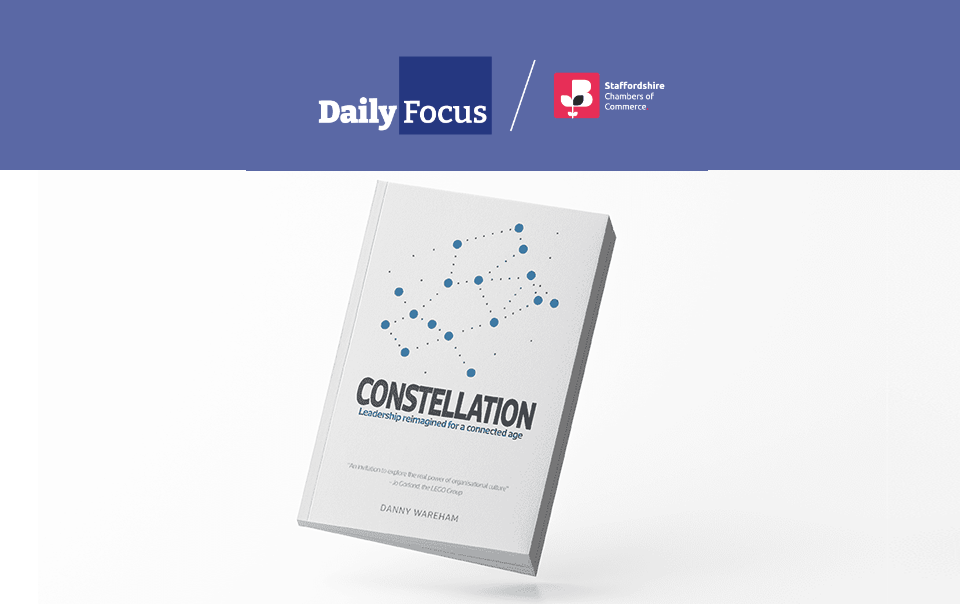
Leadership books often arrive with big promises. They promise bold frameworks, new models and diagrams that look elegant on paper but struggle to survive contact with the real world. So, settling down with Constellation on a quiet evening, we approached it with interest and a little healthy scepticism.
The premise is deceptively simple: that leadership does not always sit neatly at the top of an organisation, and that in modern, complex environments it is often culture, purpose and shared direction that do the heavy lifting. Rather than positioning leadership as something delivered to people, Danny Wareham invites us to think about how it can be created between them.
This is not a book to rush. Much like a good conversation, it rewards attention. From the opening chapters, which challenge how we currently think about leadership and culture, it’s clear that this is not a “how-to in ten steps” guide, but a thoughtful exploration of how organisations actually function when things are working well, and why they so often don’t.
Reading it as someone who spends a great deal of time with business leaders across sectors, sizes and stages of growth, much of the content felt familiar in the best possible way. The challenges described – uncertainty, misaligned priorities, managing risk – are ones I hear about regularly. What Constellation does particularly well is name these experiences clearly, without judgement, and then offer a different way of seeing them.
The central metaphor of a constellation is used lightly but effectively. Just as stars do not move into new formations but are interpreted differently depending on where you stand, leadership here is less about rearranging people and more about helping teams orient themselves around a shared “north star”. Purpose becomes the point of coordination, not control.
A theme that runs quietly but consistently through the book is a reframing of culture. This is not culture as perks, posters or a “great place to work”, but culture as the set of everyday behaviours that make great work possible. The recurring question becomes: what behaviours support our strategy, and how do we deliberately encourage more of them? It is a practical lens that will resonate with leaders trying to turn intent into action.
What stood out most was the book’s humanity. Academic ideas are present – psychology, organisational theory and systems thinking – but they are woven into stories, examples and observations that feel grounded and accessible. There is a strong sense that this has been written by someone who has spent time inside organisations, not just studying them from a distance.
Several chapters prompted me to pause and reflect on conversations I’ve had with members of the Chamber: businesses that have grown quickly and outpaced their structures; teams struggling with decision-making despite having talented people; leaders who feel the weight of responsibility but sense that the old playbooks no longer quite fit. In that sense, Constellation feels timely.
Importantly, the book does not argue for the absence of leadership, nor does it romanticise flat structures or autonomy for its own sake. Instead, it explores when leadership needs to be visible and directive, and when it can step back and allow culture and shared understanding to do the work. That nuance will resonate with anyone who has tried to lead through periods of change.
There are also thoughtful insights into individual personality and group psychological safety, encouraging the reader to think differently about themselves, their teams and how behaviour is shaped by context. I suspect I won’t look at a four-colour model in quite the same way again.
By the final chapters of case studies and practical approaches, what remains is not a checklist but a mindset shift. Leadership is reframed as something dynamic, contextual and relational rather than purely positional. For business leaders navigating complexity, growth or uncertainty, that reframing alone is valuable.
Overall, Constellation is a thoughtful, generous and quietly confident book. It doesn’t shout. It doesn’t oversimplify. And it trusts the reader to engage with ideas that are both challenging and practical. I can see why it has been shortlisted for Business Book of the Year 2026.
If you are interested in leadership that feels realistic, human and suited to the world we are actually working in, rather than the one described in org charts, this is a book well worth spending time with.