
Coaching
· Culture
· Individual
· Leadership
· Psychology
Why One-Size Coaching Fails: The Psychology We Pretend Not to See
2 March 2026
Two clients who have struggled with time management leave their coaching sessions with the same goal written at the top of their notebooks: “Build a weekly planning routine.”
The objective is practical and reasonable. Set aside an hour at the start of the week, identify priorities, block time for each task, and review progress on Friday afternoon.
It’s a simple structure, offered with quiet confidence. The coach has seen this work before and presumes it’ll work again.
For the first client, it does.
On Monday morning they open their calendar and begin to map the week. Tasks find their places. Deadlines feel visible and manageable. By Friday, there is a sense of quiet satisfaction, as the system holds and the coaching appears to be working.
The second client begins with equal intention. They buy a notebook and draw neat columns across the first page. Priorities are listed with care and optimism.
Tuesday arrives and she is surrounded by Post-Its, tabs open across three monitors, and a half-drunk cup of coffee. She’s found herself knee-deep in a new idea: a brilliant twist on a customer onboarding journey that just might save her team hours of future effort.
She hasn’t yet invoiced her last three clients, followed up on supplier delays, or reviewed this month’s budget – all tasks listed and prioritised in Monday’s notebook. But this new thing, this shiny idea, feels right. More than right: it feels good. It’s energising, important and necessary.
By Wednesday the notebook is closed. By Friday it is somewhere under a pile of papers. The week has unfolded differently than planned. Urgent conversations appeared without warning. New ideas pulled attention in unexpected directions. Work progressed, but not in the order imagined.
From a distance the conclusion might be that one client is disciplined and the other is not. One is committed. The other is resistant.
But the actual difference may be something quieter than motivation or effort. The coaching advice is identical. But the clients’ psychology is not.
One prefers structure and closure. The other prefers flexibility and possibility. One finds comfort in a plan. The other finds energy in improvisation.
This article explores personality-informed coaching, and why understanding our own psychology may be the key to reclaiming our time, delivering our objectives, and creating high-impact coaching sessions.
What is personality-informed coaching?
Coaching can be described as: “Partnering with clients in a thought-provoking and creative process that inspires them to maximise their personal and professional potential.”
It’s a finite relationship between two people, in pursuit of a specific goal or objective. Coaching – in various forms – utilises structure and methodology to help achieve those objectives.
Typically, these objectives may be linked to goal setting, skill development, performance, accountability, or relationship building.
Psychology is described as: “The scientific discipline that studies mental states and processes in humans, especially those affecting behaviour in a given context.”
Psychologists – in various forms – are interested in predicting behaviours, mental processes, measurement, mind frame, and individual differences between people. Those individual differences include our personality and how this influences our actions, decisions and behaviour.
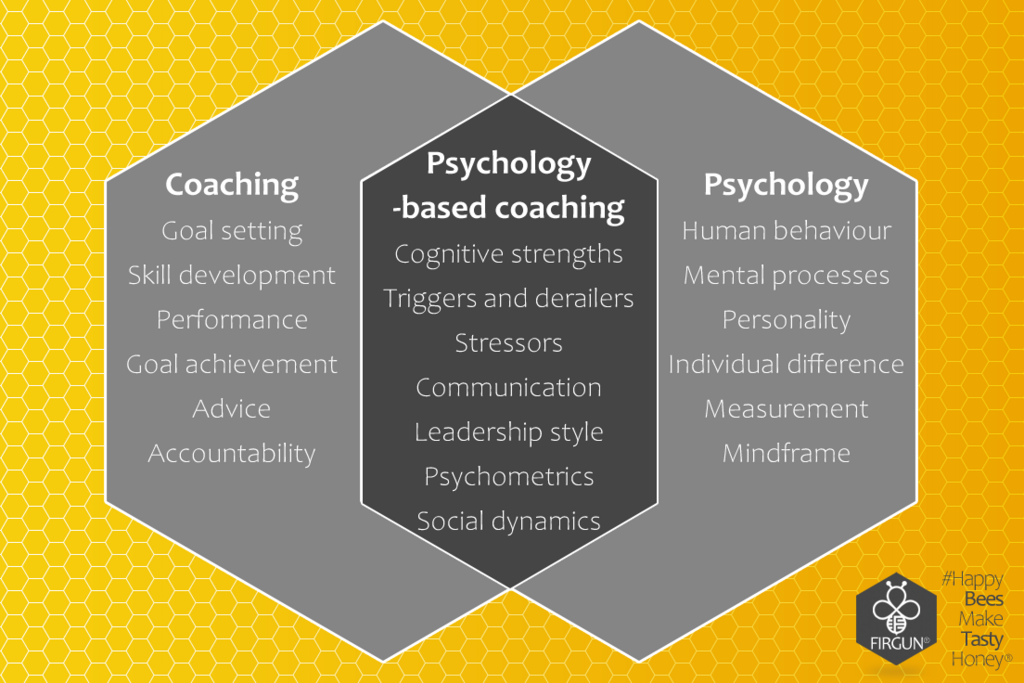 One without the other is powerful. But coaching with psychology – real, valid, reliable, scientific and evidence-based personality psychology – can be formidable.
Together, personality psychology and structured coaching focus on cognitive strengths, our triggers and stressors, communication, leadership style, and how we build and maintain relationships in groups. It can help you understand when you’re at your best and when things might blindside you, stress you or take more effort to handle.
When things take more effort, we tend to either avoid them or apply our energy into the areas that we enjoy – even when we know that those things would benefit us in the longer term. We then rationalise away those avoidance or procrastination approaches.
For example, our second coaching client finds operating flexibly and being comfortable in ambiguity more energy efficient. Planning, she might argue, isn’t a priority as sometimes things change and being shackled to a fixed process or approach is irrational.
From a personality standpoint, operating in a structured manner requires a larger amount of cognitive load for our coachee.
Cognitive energy’s impact on behaviour
This demand for cognitive energy has a profound impact on our behaviour, our stress and our wellbeing.
Our brains comprise only 2% of our body weight but use 25% of the calories we consume. Conscious cognition takes effort. It’s why you feel exhausted after a day of active listening, problem-solving and other energy-intensive tasks.
But we evolved in a time of scarcity and have remained unchanged since. We’re wired for a calorie-deficient, hand-to-mouth, life-on-the-savannah existence. When we process information and stimuli in line with this energy-efficient wiring, we’re rewarded. When we don’t, we’re exhausted.
When we think of personality, we’re usually referring to behaviour – and many assessments that claim to measure personality categorise people into “types” based on observed behaviour. But behaviour is not always the result of personality. It can be shaped by social norms, learned approaches, developed skills, conscious decisions, coping mechanisms, biases, and a range of other influences.
There may be occasions where some of these behaviours fall into common patterns: some people might prefer evidence and planning before starting a project, while others may prioritise emotional responses or group dynamics. But these can result from choice, experience, bias or learned behaviours, rather than innate personality.
For example, someone might naturally thrive in unstructured settings. However, if they don’t plan or prepare, they may struggle to run a business or manage family logistics. Over time, they learn to display behaviours that don’t reflect their underlying personality.
We are each far more rich and complex than primary colours or clusters of letters and labels can explain. Personality isn’t about reds and blues. Nor is it about being simply introverted or extraverted. It’s about our unique, nuanced differences.
As a result, we each have different strengths and derailers: when we’re at our best, and what might get in our way if we’re unaware of their influence.
This also influences which approaches and advice we apply, and which gets parked for a later date.
Personality as a language for development
Personality-informed coaching provides something that generic coaching often lacks: a shared language for understanding how change happens.
Without that language, coaching conversations can drift into vague territory. Clients are encouraged to “be more confident”, “challenge more”, or “get organised”, without a clear understanding of what makes those changes easier or harder for a particular individual.
Personality gives structure to those conversations. It allows preferences, behaviours, and patterns to be described without judgement. Rather than framing difficulties as weaknesses or failures of discipline, personality-informed coaching recognises that some approaches require more effort than others at an individual level.
Our second client is not disorganised because she lacks motivation. She is operating in line with preferences that prioritise possibility over closure and responsiveness over routine. Planning does not fail because it is the wrong approach from the coach. It fails because it demands sustained cognitive effort in a way that improvisation does not for the coachee.
Naming these differences changes the tone of coaching. What might previously have been framed as resistance can instead be understood as a predictable response to cognitive demand.
This offers the coach and the coachee an opportunity to discuss strategies to discuss energy, procrastination and when we might get in our own way in pursuit of the goal.
Personality also provides a way to talk about energy. Some activities are naturally energising, while others require sustained effort simply to begin. When coaching ignores these differences, goals can be technically correct but psychologically unrealistic.
An individual who is naturally cautious and risk aware might consciously understand that they need to try something new. But their subconscious will work against that rationality to protect their energy, resulting in an increased likelihood of requiring more evidence, data or reassurance to provide the psychological safety needed to go against their default wiring.
When personality is part of the conversation, development becomes less about forcing behaviour and more about designing approaches that people can sustain. A planning system for our second client might need to be shorter, more flexible, or visually engaging. Accountability might come through conversation rather than routine, and structure might exist in bursts rather than across an entire week.
The goal does not change. The route does.
This is where personality-informed coaching becomes particularly powerful. It does not lower expectations or excuse avoidance. Instead, it allows coach and client to distinguish between what is difficult because it matters and what is difficult because it conflicts with natural preferences.
That distinction matters. Without it, coaching risks becoming an exercise in persistence alone: try harder, be more disciplined, repeat the method. With it, coaching becomes an exploration of how a person actually operates, and how change can be achieved without unnecessary strain.
Personality, in this sense, is a map of how someone tends to process information, make decisions and direct their energy.
But maps do not determine where we travel. Instead, they make it easier to choose a route that we can realistically follow.
Personality-informed coaching therefore sits at the intersection of structure and psychology. Coaching provides direction and accountability. Personality provides understanding. Together they allow development to be both intentional and sustainable.
Coaching plus
Coaching is often described as a personal journey. Yet many of us pursue that journey using methods designed for someone else.
When development this works, we rarely question why. When it fails, we often assume the fault lies with our effort or discipline.
Personality-informed coaching invites a different question. Not “What should I be doing differently?” but “How do I naturally operate, and what would development look like if it worked with that rather than against it?”
Every coaching session, every piece of advice, is filtered through the mind it lands in. The advice we receive may be sensible and the goals we pursue may be worthwhile. But before accepting that an approach simply requires more effort, it may be worth asking a quieter question:
“Is this the right method for me, or just the most common one?”
References
Jones, R. J., Woods, S. A., & Hutchinson, E. (2014). The influence of the Five Factor Model of personality on the perceived effectiveness of executive coaching. International Journal of Evidence Based Coaching and Mentoring, 12(2), 109–118.
Oades, L. G., Steger, M. F., & Passmore, J. (2017). Coaching and positive psychology: A practical guide to flourishing and well‑being. Wiley.
Palmer, S., Cavanagh, M., & Whybrow, A. (2008). The coaching psychology manual: Developing reflective practice. Routledge.
Ryan, R. M., & Deci, E. L. (2000). Self‑determination theory and the facilitation of intrinsic motivation, social development, and well‑being. American Psychologist, 55(1), 68–78.